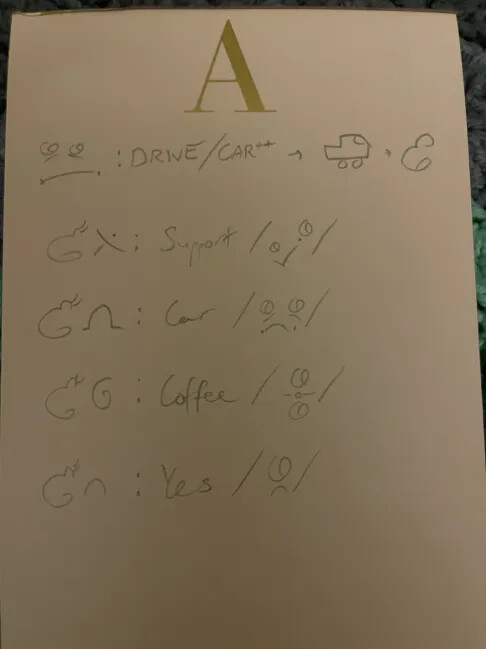
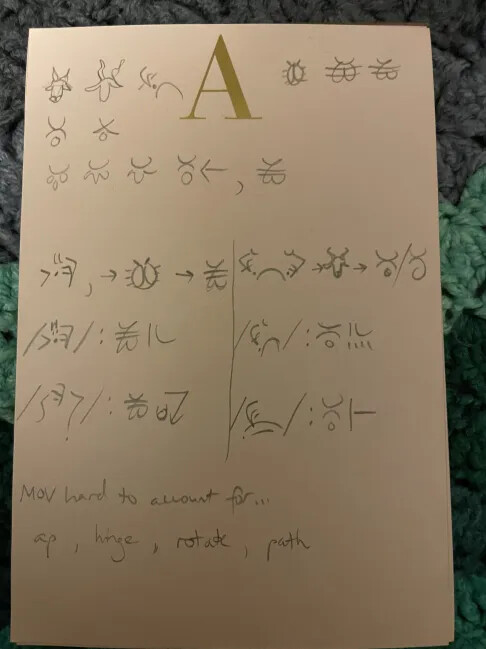
I've been doing some reading on Diane Brentari's prosodic model of sign phonology. Still got a lot more to do, but it's been giving me a lot of ideas that I want to use for a writing system!
Signwriting is difficult at the best of times, and people tend to go the route of showing all of the 5 parameters, either in a line or arranged in 2d space ("projectional"). This is fine, but does feel very alphabetic, you know what I mean? They're also suuuuper featural, and I personally tend to quite dislike featural systems.
There are some systems that play around with different ideas, like a more abjad-y or logographic system. ASLwrite is like an abjad how it drops parameters and implies orientation through location. jan Olipija (of Luka Pona fame) has been working on a logography for BSL for a couple years now. Sutton combines orientation with the handshape.
All of this is well and good, but we've still not really been treading new ground. Especially linear systems usually encode pretty much the same info. What I propose instead is a syllabary! Or rather in this case a semisyllabary.
Basically, I wanna take Brentari's inherent (handshape and location) versus prosodic (movement) feature analysis, and then make a character for each configuration within those groups. So for inherent you can have like "{5} on the chest, {5} on the chin, {1} in neutral, etc." and for prosodic you'd have different movement patterns and such.
Symbols are gonna be made through fake evolution. I'll draw a word that has the same IFs, and then abstract into a character. Planning some fun stuff with potential stacking for complex syllables.
For now, back to the books to get a stronger theoretical base! I leave y'all with this to check out!